I pulled two years of my own delivery history to answer a question memory alone couldn’t settle: did AI-assisted delivery actually change what I can carry, or does it just feel that way?
This is raw telemetry, not a highlight reel. Every number below is pulled directly from git log on local clones and the GitHub API, across everything I own, contribute to, or can access through client and collaborator organizations — instrumented for a short series on what changed in how I ship. I lay out what the pattern means in AI-Amplified Engineering: The Multiplier Is Discipline, Not the Model; this is the data underneath it.
Window: August 2024 – August 2026. Source: git + GitHub API, 426 repositories.
Repos in scope
Commits, trailing 24mo
Concurrent orgs / clients
Repos active this window
AI-assisted delivery didn’t make me type faster. It raised the number of engagements one engineer can carry at full depth, at the same time — and the git history shows exactly where that shift happened.
Delivery cadence
Monthly commits, trailing 24 months. Output didn’t rise on a steady slope — it moved in step-changes, each one landing after a shift in tooling or workflow.
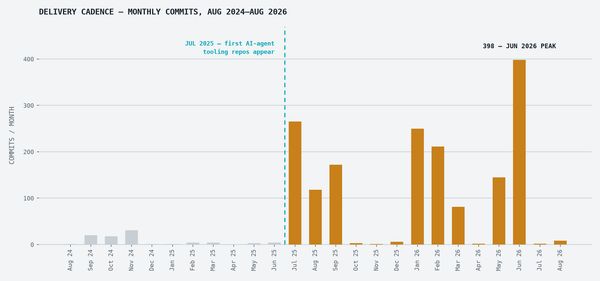
Read that chart closely and it complicates a too-easy story. It isn’t a rising line — several months are flat zero or near it (April 2025, October–November 2025, April 2026), sitting right next to peaks that keep exceeding each other after July 2025, when the first AI-agent tooling repositories show up in the same history (delivery-agent, tessie-agent, codex-mcp-hub, among others). The real pattern isn’t a steady productivity gain, it’s a rising ceiling on what a single burst can carry. Engagement-driven consulting work looks like this. A smooth curve wouldn’t.
Technology footprint
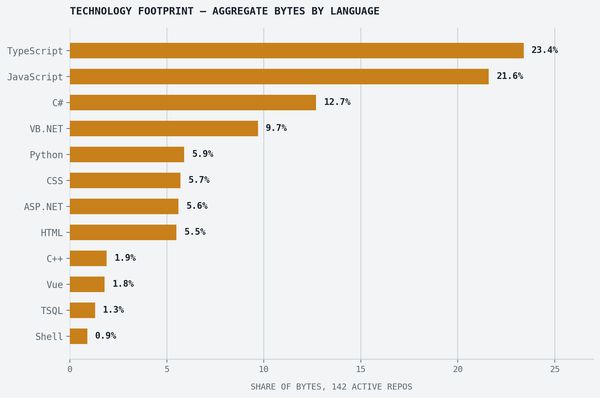
Aggregate bytes of code across the 142 active repositories, ranked. TypeScript and JavaScript dominate; the long tail runs from embedded Rust to legacy .NET to infrastructure-as-code.
Portfolio at a glance
Breadth over depth-in-one-place: access spans a personal account and eight organizations, most of it private client work.
owned vs. org-accessible
public vs. private
active vs. dormant (24mo)
organizations engaged
Notable engagements
Ranked by commit volume, recency, and stars. Client work is named only where it’s already public — everything else is tagged by domain, not company.
| Repo | Description | Volume |
|---|---|---|
gcp_sms_gatewayprivate |
SMS gateway product built on GCP Cloud Functions — highest commit volume in the window. | 383 commits / 24mo |
delivery-agentprivate — AI tooling |
Agentuity-based autonomous delivery agent — part of the 2025–26 AI/agent-tooling build-out. | 172 commits / 24mo |
fall_sensorprivate — healthcare/IoT |
ESP32-C6 + mmWave radar fall-detection device, fielded in production in Colombia. | 156 commits / 24mo |
gatejumpprivate |
Node service and utilities, deployed via Docker Swarm. | 128 commits / 24mo |
tessie-agentprivate — AI tooling |
Autonomous test-generation agent — early entry in the AI-tooling cluster. | 100+ commits / 24mo |
[client repo]private — automotive/industrial |
One of 20+ repos in a long-running enterprise .NET modernization effort for an automotive/industrial engineering services client. | 75 commits / 24mo |
parametric-estimatorprivate — AI tooling |
COCOMO II / Function Points / Use Case Points estimator, agent-built. | 53 commits / 24mo |
Patterns worth naming
Cadence. Output moves in bursts tied to engagements, not a steady weekly rhythm — three sharp peaks (Jul '25, Jan–Feb '26, Jun '26) separated by quiet stretches. Reads as concurrent, deep engagements rather than one continuous codebase.
Tooling shift. A distinct AI/agent-tooling cluster — delivery-agent, tessie-agent, codex-mcp-hub, coderabbit-fix-bot — didn’t exist in 2024 and now runs alongside every other line of work.
Enterprise thread. A 22-repo enterprise .NET estate is mid-modernization in 2026, with “new”-prefixed rewrites shipping next to the originals they’re replacing.
Embedded constant. A Rust/embedded thread — Embassy on STM32 and ESP32, mmWave sensing — runs continuously under the web and .NET work for the full 24 months, never dropped.
Methodology
Commit counts combine exact git log --author history from 42 local clones with GitHub API commit search (capped at 100 commits/repo/call) for active repos with no local clone — a real undercount risk for the two highest-volume repos. 284 repositories with no push in the trailing 24 months were excluded from analysis. Language stats cover the 142 active repos only. Private repos are described by inferred domain, never by client name.
Next: what a 10x week actually looks like, hour by hour.